A television is one of the most frequently used appliances in most Indian homes. It's on for several hours a day, often in rooms that experience temperature swings, dust, humidity, and voltage fluctuations — all of which take a toll on the internal electronics over time.
The good news is that most premature television failures are avoidable. The faults we see most often in our workshop — failed capacitors, overheated boards, dust-clogged vents, and voltage surge damage — are largely preventable with straightforward habits and a modest investment in protective equipment.
This guide covers the most practical steps you can take to extend your television's working life, reduce repair frequency, and get full value from your purchase.
1. Ventilation and Heat Management
Heat is one of the primary causes of electronic component failure over time. The capacitors, power transistors, and integrated circuits inside a television are all rated for specific operating temperatures, and sustained operation above those temperatures accelerates degradation — particularly in electrolytic capacitors, which are among the first components to fail in heat-stressed televisions.
Modern LED and LCD televisions generate heat primarily from the power supply board and the LED backlight driver circuit. This heat needs somewhere to go, which is why televisions have ventilation slots — usually along the back and sides of the cabinet.
What to Do
- Never install a TV flat against a wall with no air gap. Leave at least 5–10 cm of clearance behind the set to allow air circulation.
- Avoid placing a TV inside enclosed media cabinets without ventilation openings. A fully enclosed cabinet can raise internal TV temperature significantly.
- Do not stack other electronics directly on top of or directly below a television.
- In rooms without air conditioning, ensure general air circulation — a ceiling fan helps considerably during hot Indian summers.
- Check that ventilation slots on the back of the TV are clear and not blocked by cables, dust accumulation, or wall proximity.
In our experience, televisions mounted flat to walls in enclosed alcoves run significantly hotter than free-standing sets. This is one of the most common contributing factors to early power board failure we see in Gurgaon homes.
2. Dust Prevention and Cleaning
Dust accumulation inside a television is a problem most people don't think about — the television appears sealed from the outside, but ventilation slots allow dust to gradually enter and settle on internal components. Over time, a layer of dust acts as thermal insulation on components that need to dissipate heat, and can also bridge circuit traces on boards in high-humidity conditions.
Gurgaon has significant dust levels, particularly in summer months when dry winds carry particulate matter. Televisions in homes near roads, under construction areas, or in older buildings accumulate internal dust faster than those in less dusty environments.
Cleaning the Exterior and Vents
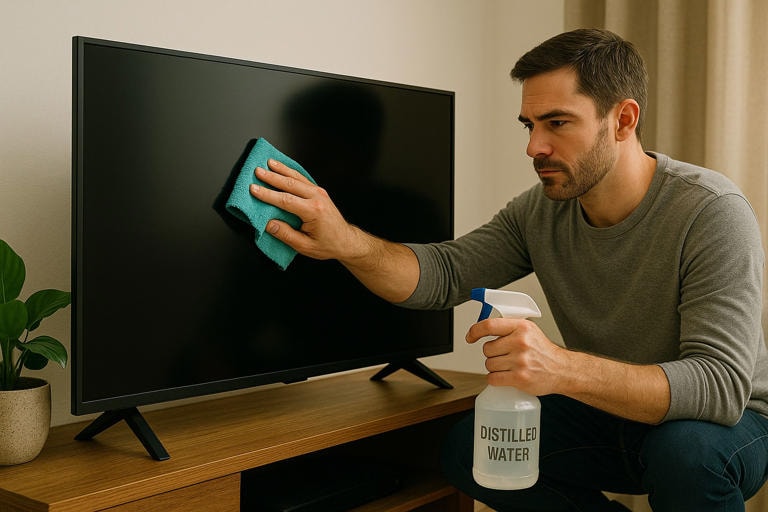
- Use a dry microfibre cloth for the screen. Avoid paper towels, which can cause micro-scratches on anti-glare coatings.
- Never spray liquid cleaning products directly onto the screen. Apply to the cloth and wipe gently.
- Use a soft brush or low-powered compressed air to clear the ventilation slots on the rear cabinet every few months.
- Keep the area around the TV reasonably dust-free. Regular dusting of the room reduces how much dust the ventilation system draws in.
Internal Cleaning (Professional Service)
Internal cleaning is not a DIY task for most people. Opening a television safely requires understanding which high-voltage components to avoid — particularly the power board, which can retain charge even when unplugged. If you want the internal boards cleaned, bring the TV to a qualified technician. We offer internal cleaning as part of general servicing at our workshop.
3. Voltage Protection
Voltage fluctuation and power surges are a significant cause of television damage in India. The power supply board in a television is designed to handle a reasonable range of input voltage, but sharp spikes — common during thunderstorms, at the start of power cuts, or when large appliances switch on — can damage components beyond their rated tolerance.
The power board's capacitors and MOSFETs are the most vulnerable components to voltage events. In many cases, a single large surge can immediately damage a power board. More commonly, repeated minor fluctuations degrade capacitors gradually until they fail.
Protective Equipment
- Stabiliser: A voltage stabiliser regulates the incoming mains voltage and protects against sustained high or low voltage. This is particularly valuable in areas with known voltage fluctuation problems.
- Surge protector: A surge protector (with genuine MOV surge suppression, not just a basic multi-socket board) absorbs brief high-voltage spikes before they reach the TV.
- UPS: An uninterruptible power supply provides both stabilisation and surge protection, and also ensures a clean shutdown if power cuts occur.
- Switching off during thunderstorms: The most effective surge protection is simply unplugging the TV during electrical storms. A direct or nearby lightning strike can overwhelm even quality surge protectors.
4. Display Care
The panel itself — whether LCD, LED, or OLED — is the most expensive single component in a television. Physical damage to the panel is generally uneconomical to repair in any but the largest and most expensive sets, so prevention matters.
Screen Damage Prevention
- Never touch the screen with fingers if avoidable. Skin oils can degrade anti-glare coatings over time and create spots that are difficult to remove.
- Keep children and objects away from the screen surface. Even light pressure from a finger can cause pressure marks on some panels.
- When cleaning, use only minimal pressure. Excessive wiping force can damage the panel layers.
- For wall-mounted TVs, ensure the bracket is rated for the TV's weight, is fixed to a solid wall or stud, and that the mounting hardware is tightened correctly.
Brightness and Image Retention
Operating a television at maximum brightness for extended periods accelerates backlight degradation (in LED sets) and can cause image retention or burn-in (particularly in OLED panels). Setting brightness to a comfortable rather than maximum level reduces long-term panel wear.
Most televisions shipped in India default to a vivid or dynamic picture mode in the shop to catch attention under bright retail lighting. This mode typically runs the backlight at near-maximum intensity. Switching to a standard or cinema mode at home will reduce brightness to a more appropriate level and extend backlight lifespan.
5. Humidity and Environment
High humidity can accelerate corrosion on circuit board traces and connector pins. Televisions in rooms prone to high humidity — kitchens, bathrooms, or poorly ventilated rooms in monsoon season — are more susceptible to this type of damage.
- Avoid placing televisions in rooms where cooking steam or bathroom humidity regularly enters.
- During monsoon months, ensure adequate ventilation in rooms where televisions are used.
- If the TV has been moved from a cold to a warm environment, let it acclimatise for 30–60 minutes before switching on, to allow any condensation to evaporate.
6. Remote Control and Input Port Care
These are small points but worth mentioning. HDMI ports are relatively delicate — repeatedly inserting and removing cables at an angle, or using cables with heavy connectors that put leverage on the port, can damage the port solder joints on the main board. This is a repairable fault but an avoidable one.
- Insert HDMI cables straight and gently. If a cable is difficult to seat, check the connector for debris rather than forcing it.
- Consider using HDMI cable right-angle adapters on wall-mounted TVs where cables would otherwise put lateral pressure on ports.
- Replace remote control batteries before they fully discharge and leak — leaked batteries can damage the remote's circuit board.
Summary
Most of the steps above are simple habits rather than significant investments. The ones with the greatest impact are voltage protection, adequate ventilation, and keeping the screen and vents clean. A television that is well ventilated, protected from power surges, and kept in a dust-managed environment will statistically have fewer faults and a longer useful life than one in an unmanaged environment.
If your TV does develop a fault, early attention usually means a smaller repair. A capacitor replaced early costs significantly less than a board that has failed completely due to extended operation in a degraded state. If you notice any unusual behaviour — intermittent shutdown, flickering, unusual sounds — it is worth having it checked rather than waiting for a complete failure.
We're based in Jacobpura, Sector 12, Gurugram and offer home visits across Gurgaon.