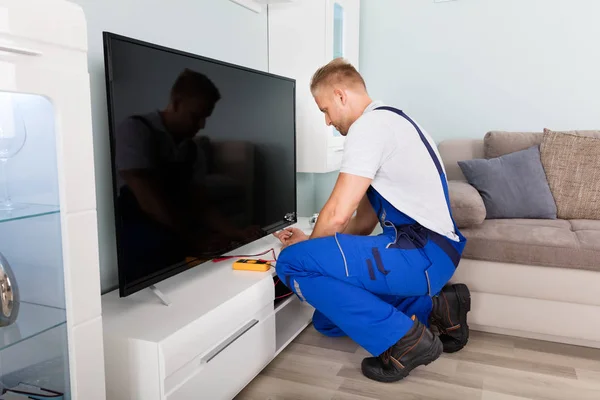
Should You Repair or Replace Your Broken TV? The 2026 Answer That Could Save You ₹30,000
Your television just went dark — or started flickering, or shows lines you can't get rid of. Before you start browsing for a new one, take five minutes to read this. The real numbers might completely change your decision.
By the TV Repair Gurgaon Editorial Team
Updated June 2026
8 min read
0Average repair cost (₹)
0%Repairs cheaper than replacement
0 kgE-waste per discarded TV
Every year, millions of functioning televisions are discarded simply because owners assumed a new purchase was the only option. According to the Global E-waste Monitor, India generated over 1.6 million tonnes of e-waste in 2022 — and consumer electronics, including TVs, are a significant contributor. Most of those devices could have been repaired.
The decision to repair or replace depends on three variables: the type of fault, the TV's age, and the cost of repair relative to replacement. This guide walks through each one with real numbers so you can make an informed choice — not an expensive impulse decision.
The 50% Rule (widely used by repair professionals)
If the repair cost is less than 50% of what a comparable new TV would cost, repair is almost always the better financial choice — especially for TVs under 6 years old.
The Most Common TV Faults — And What They Actually Cost to Fix
Not all TV problems are created equal. A blown capacitor in a power board is a ₹200 component repair. A physically cracked OLED panel is a different story entirely. Here's a factual breakdown of the most common fault types and their typical repair cost ranges in India (2024–2026):
Fault / Symptom
Typical Repair Cost
Common Verdict
TV won't turn on (power board)
₹800 – ₹2,500
✔ Repair
Dim / dark picture (backlight failure)
₹1,500 – ₹4,000
✔ Repair
No picture, has sound (T-CON board)
₹1,200 – ₹3,500
✔ Repair
Vertical / horizontal lines on screen
₹1,500 – ₹5,000
⚠ Assess
Wi-Fi not connecting (Smart TV module)
₹1,000 – ₹2,500
✔ Repair
Motherboard / main board failure
₹2,500 – ₹8,000
⚠ Assess
Physically cracked screen (panel)
₹8,000 – ₹25,000+
✖ Often Replace
HDMI port not working
₹600 – ₹1,800
✔ Repair
Remote not responding (IR sensor)
₹300 – ₹900
✔ Repair
No sound (audio IC / speaker)
₹800 – ₹2,500
✔ Repair
*Cost ranges are indicative for Gurugram / Delhi NCR region (2026). Actual costs depend on brand, model, and parts availability. Always get a written quote before authorising any repair.
Repair vs Replace Cost Calculator
Enter your details below to get an instant recommendation based on the industry-standard 50% rule and TV age.
Quick Diagnostic Quiz
Answer 4 questions and get a personalised repair or replace recommendation in under a minute.
Question 1 of 4
How old is your TV?
Clear Signs You Should Repair Your TV
The TV is under 6 years oldMost modern LED and Smart TVs are built to last 8–10 years. Under 6, the display and electronics typically have significant life remaining. Repair economics are strongly in your favour.
The fault is in the power supply, backlight, or a board (not the panel)These are the most commonly repaired components. Parts are widely available and repair costs rarely exceed ₹4,000. This is always cheaper than replacement.
Repair cost is under 40% of a comparable new TV's priceThe standard industry benchmark. At this ratio, repair wins financially every time, even accounting for future maintenance probability.
The TV is a higher-end model (QLED, OLED, 75"+)Premium TVs cost ₹80,000–₹3,00,000+ new. Repairing even a complex fault for ₹8,000–₹15,000 is an obvious financial win on a set that still delivers excellent picture quality.
The problem appeared suddenly (not gradual deterioration)A sudden failure is typically a single component fault — a capacitor, a fuse, a board. These are precise, fixable problems. A TV degrading slowly over time may have systemic issues.
When Replacing Your TV Makes More Sense
The panel (screen) is physically cracked or shatteredPanel replacement costs are extremely high — often ₹15,000–₹25,000 for a 43" TV — and can exceed the purchase price of a new TV of the same size. Physical damage to the display usually tips the balance toward replacement.
TV is over 10 years old and this is the second major repairAfter 10 years, multiple components are near end-of-life. Fixing one board may just allow another to fail in six months. The cost-benefit of continued repair diminishes sharply.
The repair quote exceeds 60–70% of a new TV's priceAt this ratio, financial logic clearly favours replacement. A new TV also comes with a manufacturer warranty (typically 1–2 years) that provides protection against early faults.
Parts are no longer available for your modelOlder models (especially some Chinese brands) lose spare parts availability after 5–6 years. If a reputable technician can't source genuine parts, this is a genuine barrier to a quality repair.
⚠ Watch Out For This
Be cautious of "local" repair shops that offer to repair your TV without providing a written quote or warranty on the repair. A reputable service centre will give you a free or low-cost initial diagnosis before any work begins, and provide a written estimate before proceeding.
What People Say After Choosing to Repair
★★★★★
My 55" Samsung LED suddenly went blank. I was ready to buy a new one. The technician diagnosed a backlight failure and fixed it for ₹3,200. The TV looks perfect now. Genuinely saved me ₹40,000.
RS
Rahul S.
Sector 49, Gurugram
Verified local review
★★★★★
LG Smart TV stopped connecting to Wi-Fi completely. I thought it was time for an upgrade. The Wi-Fi module was replaced for ₹1,800. Works better than ever. Should have called a repair shop first!
PM
Priya M.
DLF Phase 2, Gurugram
Verified local review
★★★★☆
Sony Bravia had horizontal lines on the screen. Diagnosed as T-CON board issue. Repaired in 2 days for ₹2,800. Honest quote with no hidden charges. Very satisfied with the transparency.
AK
Amit K.
Sushant Lok, Gurugram
Verified local review
★★★★★
My Panasonic plasma was 8 years old but still displayed a brilliant picture. Power supply failed. The technician honestly said it's worth repairing and fixed it for ₹2,100. Excellent advice and service.
NJ
Neeraj J.
South City, Gurugram
Verified local review
Useful Products & Resources for TV Care
Whether you're maintaining your repaired TV or preparing for a new purchase, these resources are worth exploring. These are external links — we receive no commission from these recommendations.
Amazon India
Voltage Stabilizer for LED/LCD TV (up to 65")
A quality voltage stabilizer protects your TV's power board from fluctuations — one of the leading causes of premature failure in Indian homes. V-Guard and Microtek are reliable brands.
Using incorrect cleaning products (like alcohol or harsh sprays) on modern TV screens causes permanent haze and coating damage. A proper screen-safe kit prevents this.
Surge protectors with MOV protection guard all connected electronics from lightning strikes and power spikes. Essential for protecting any entertainment setup.
iFixit maintains a large library of free TV repair guides, including step-by-step disassembly instructions and fault diagnosis flowcharts for many common models.
43" 4K LED Smart TV (Budget Category, Under ₹30,000)
If replacement is the right choice, current 2024–2026 models from TCL, Hisense, and Vu offer excellent value at this price point. Compare before buying.
If your TV genuinely cannot be repaired, don't throw it in general waste. The Central Pollution Control Board maintains a directory of authorised e-waste recyclers across India.
Shine a bright torch at the screen in a dark room while the TV is on. If you can see a faint image, the display panel and electronics are functioning — the backlight has failed. This is one of the most repairable and cost-effective faults. Backlight strip replacement typically costs ₹1,500 – ₹4,000 depending on the TV size and model.
No. If your TV is within the manufacturer's warranty period (typically 1–2 years in India), always contact the manufacturer's authorised service centre first. Using an independent repair shop will usually void the remaining warranty. Only seek independent repair after the warranty has expired.
Most common repairs — power board, backlight, T-CON board — can be completed within 1–3 days if parts are in stock. Component sourcing for less common models may extend this to 5–7 days. Complex motherboard repairs requiring component-level rework may take slightly longer. Always ask for an estimated turnaround time before leaving your TV.
Key questions: (1) What exactly is the diagnosed fault? (2) What is the total cost including parts and labour? (3) Are you using genuine or compatible parts? (4) Is there a warranty on the repair itself? (5) What happens if the TV develops a different fault within 30 days? A reputable technician will answer all of these clearly. Avoid shops that won't provide written quotes.
Yes — power board capacitor failure is one of the most common TV repair jobs in India, and voltage fluctuations are a primary cause. In areas with unstable power supply, a quality voltage stabilizer (₹1,200 – ₹3,500) is a worthwhile investment that can significantly extend a TV's lifespan. Look for stabilisers with input voltage range of 90V–280V AC for Indian conditions.
Frequently, yes. Many Smart TV problems — apps crashing, slow performance, Wi-Fi issues, firmware errors — can be resolved through firmware updates, factory resets, or cache clearing. Before spending money on a repair, try: (1) disconnecting from power for 60 seconds (power cycle), (2) factory reset via the settings menu, (3) checking for available firmware updates. If these don't resolve the issue, a technician can diagnose whether it's a software or hardware fault.
The Environmental Case for Repairing Your TV
The financial argument for repair is strong — but there's an equally compelling environmental one. Manufacturing a new 55" LED television generates an estimated 600–900 kg of CO₂ equivalent across its production lifecycle, according to lifecycle assessment data published by the European Environment Agency.
A typical television also contains 4–8 kg of hazardous materials including lead (in solder), mercury (in older CCFL backlights), cadmium, and brominated flame retardants. When discarded irresponsibly — as most consumer electronics in India currently are — these materials leach into groundwater and soil.
The Right to Repair movement in India
India's Ministry of Consumer Affairs has been developing a Right to Repair framework since 2022, which aims to ensure that manufacturers provide spare parts, technical documentation, and software updates to consumers and independent repair shops. This is expected to reduce e-waste and lower repair costs further in coming years.
Choosing to repair rather than replace — even just once — prevents your TV from contributing to the approximately 50 million tonnes of e-waste generated globally each year (UN Global E-waste Monitor, 2024).
5 Things You Can Do Right Now to Extend Your TV's Life
Install a voltage stabilizerPower fluctuations are the single biggest cause of premature TV component failure in India. A basic stabilizer costs under ₹2,000 and can double the lifespan of your TV's power board.
Ensure proper ventilationTVs need 10–15 cm of clearance on all sides for heat dissipation. Mounting in enclosed cabinets without ventilation causes overheating, which degrades capacitors and boards over time.
Use sleep/off timers instead of standbyModern TVs in standby still draw 0.5–5W continuously. More importantly, long standby periods keep power circuits energised unnecessarily. Use scheduled off-timers for TVs that are regularly left in standby overnight.
Reduce backlight brightnessFactory brightness settings are often set extremely high for showroom visibility. Reducing backlight to 40–60% in a typical home environment significantly extends LED strip lifespan without noticeably impacting picture quality.
Clean vents and back panel annuallyDust accumulation in ventilation slots acts as thermal insulation, causing internal temperatures to rise. A gentle clean with compressed air (not vacuum, which can generate static) once a year prevents heat-related failures.